Barkley Cove Courthouse
Where the Crawdads SingBarkley Cove Courthouse is the civic center where the county’s history, the town’s social order, and the public judgment of Kya Clark converge. The courthouse’s formal authority sits within a landscape steadily reclaiming its grounds, while its courtroom stages a trial shaped by prejudice, racial segregation, and the possibility of a death sentence. It is both a working seat of government and the setting for the decisive public reversal of Kya’s prosecution.
County Seat and History
Barkley Cove became the county seat because it was the first village settled in this marshy stretch of the North Carolina coast. The Crown established its governmental importance there, and the original courthouse was built in 1754. Although other towns, including Sea Oaks, later became more populous and developed, Barkley Cove retained its official role as the county’s administrative hub. The courthouse’s position therefore outlasted the growth of its rivals: political centrality belonged to the older settlement even as the region changed around it.
Lightning struck the original courthouse in 1912 and burned much of its wooden structure. The building was reconstructed the following year on the same square at the end of Main Street, this time as a two-story brick courthouse. By the 1960s, its surroundings no longer looked carefully maintained. Wild grasses, palmettos, and cattails had spread across the grounds, and a lagoon choked with lilies flooded in spring and gradually consumed part of the sidewalk. The county’s official center thus remained in place, but the marsh pressed visibly against the order its architecture represented.
Building and Courtroom
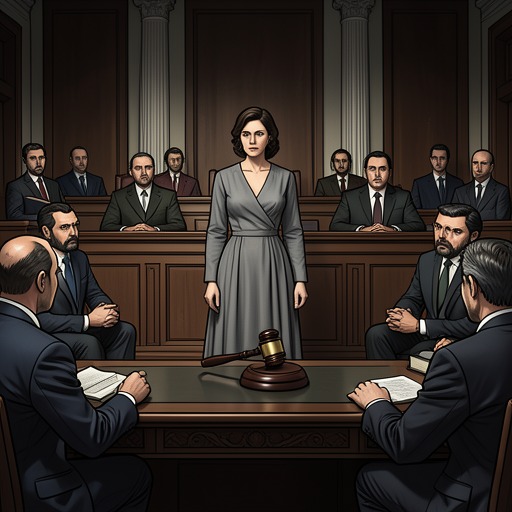
The rebuilt exterior was a brick structure with twelve-foot windows trimmed in granite. Inside, the courtroom was designed to reproduce the character of the original and presented a deliberately imposing face: the judge’s bench rose above the room, its dark mahogany marked by a colorful inlay of the state seal. Multiple flags hung above it, including the Confederate flag. The jury box’s half wall was also mahogany, edged in red cedar, while the windows along one side framed the sea. The room’s elevated bench and ceremonial fittings made the authority of the court tangible; the view beyond its windows kept the surrounding coastal landscape in sight.
The courthouse also had its own familiar presence in Sunday Justice, a black-and-white cat with green eyes. A fixture there for years, he had earned his place by clearing rats from the basement and mice from the courtroom. During the trial, he stretched in a patch of sunlight on a deep windowsill while the gallery filled around him. His calm, habitual occupation of the building contrasts with the charged attention focused on Kya and the case.
The Trial and the Public Gallery
On the morning the trial opened, by 9:45 the gallery had overflowed with villagers. People filled the pews, crowded the rear and the spaces beside the tall windows, and murmured over the evidence and the prospect of the death penalty. Journalists from the Atlanta Constitution and the Raleigh Herald occupied a section near the front. The proceedings were public spectacle as well as legal business: the crowd’s interest in the accused as the Marsh Girl made the courthouse a place where community gossip and formal accusation occupied the same room.
That community was divided even in its seating. A small rear balcony could hold twenty more people, and although no sign marked it, everyone understood that Black spectators were restricted there. On this occasion it held mostly white people, with only a few Black attendees; the trial was regarded as a white case. The courtroom therefore displayed racial exclusion through an understood custom rather than a posted rule. Above the room’s movement and whispers, the Confederate flag supplied another visible reminder of the history embedded in the building’s symbols.
When Judge Harold Sims took the bench, he denied Tom Milton’s motion to move the trial to another county. The defense had argued that prejudice against Kya in the community made a fair trial impossible. Judge Sims acknowledged her unusual circumstances and that she had experienced some prejudice, but concluded that the evidence did not establish more prejudice than people faced in small towns across the country, or even in some larger ones. The court would proceed in Barkley Cove. He then formally charged Kya with first-degree murder of Chase Andrews, explaining that the charge concerned a premeditated act and that the state intended to seek the death penalty if she were found guilty.
Verdict and Departure
The courtroom’s role changed when the jury returned its verdict. The foreman delivered a note to the bailiff, who passed it to Judge Sims; the judge then handed it to the recorder, Miss Jones. She stood and read that the jury found Kya not guilty of first-degree murder. Kya buckled into her seat, and Tom followed. Tate Walker, Jodie Clark, and Mabel reacted with visible relief, while the gallery initially sat motionless, apparently unsure it had heard correctly. Whispers rose into angry questions, and one spectator called out that the verdict was wrong. Judge Sims restored order with his gavel, declared Kya free to go, and apologized on behalf of the state for the two months she had spent in jail.
As Kya left with Jodie through the courtroom’s back door, she touched Sunday Justice’s tail on the windowsill. The cat ignored her, and she admired his practiced pretense of not needing a goodbye. Outside, the opened door brought the breath of the sea to her face. The exit carries the courthouse’s final contrast: inside, the state had confined and judged her; beyond its doors, the coastal world she knew awaited her return.